Thursday, March 27, 2014

Friday 21st March: Goodbye London, Hello Kenilworth and Margaret!

We packed up our belongings first thing; not an easy task since we have to cram a lot of stuff into the small suitcases we chose to bring.  I brought a backpack because I thought it would be easy to carry but I discovered that you simply can't sit down with it on and it is otherwise very awkward. I've got to look for another carry on with 4 wheels; 2 wheels are not adequate when you are trying to slide a bag forward.

Saying Good-bye to the Grand Royale

The Reading Room


Bus stop on Bayswater at Inverness Terrace, a very convenient location!
After breakfast, we made our way down and out to the bus stop and took another very convenient bus to Victoria Station.  It left us off about two blocks away from the "Coach Station" where the intercity buses leave from; not too bad, but thank goodness for wheels on our suitcases!


We had booked the Megabus for the trip to Kenilworth, only a couple of miles from Coventry, which itself is only 10 or so miles from Birmingham (Birmingum in Brit speak), one of England's largest cities. This is where Evie's friend Margaret lives; it cost only L6 for both of us!  (Remember that the L stands for "pounds".) The bus was comfy and had to wend its way all through London for 45 minutes before even reaching the "motorway". Good for sightseeing, but nothing like the speed of the trains, which we will be using from now on.

Map of first leg of journey


We got in a little after 2PM but not to a bus station; since it was the Megabus, it left us in front of a Tesco store!  Margaret was right there waiting for us and we laughed as we crammed our luggage into her tiny car and drove off toward her house.

The streets are very narrow here i with cars parked sometimes on both sides so there is room only for one car to pass throug, even though it may ostensibly be a two way street.  I watched as she had to stop and wait for oncoming traffic to pass before she could proceed on multiple occasions during the short drive.

Parking is difficult since few have garages. Margaret's house is around the corner!
Margaret's house has the black door on the left
We walked down the block from where she was able to park and sherpa'd our luggage upstairs to her daughter's old room. We had a quick tour of the house; two bedrooms, one bath with a small kitchen and dining area, and a delightful back 'garden' (they don't say yard), which opens to a large field.  The house dates to 1901, as is part of a long block of what we might now call "zero lot line" houses; wall to wall, continuous houses, with front doors opening directly to the sidewalk, which is but 3 feet wide.  These are called "terraced" houses and comprise most of the homes in England.

After a little "lie down" to recuperate, Margaret suggested that we walk down to a local pub for dinner. The walk took us down one street and up another, by a local abbey, then across a park; it was quite a long walk for us as we both are not really used to walking any real distance in the cold night time air and we joked about it with our hostess; however, Margaret  is very used to walking and prefers to this mode of travel to driving the car which is why she (and most Brits) seem to be very slim with no weight issues!

We each had a very nice meal; I had swordfish steak with a dill sauce and Evie had Hake fish. After a later wiki search I found that Hake is a relative of cod, and along with Haddock, and is one of the most common fish consumed in these parts, although under severe pressure of overfishing. My swordfish was delicious and we finished off with apple crumble with warm custard on top; yummy! We walked off the calories getting home and after a little tele' and talk, trundled upstairs to bed.


Wednesday, March 26, 2014

Thursday 20th March: Buckingham Palace and St. Paul's Cathedral

This is our last day before we depart for the country to visit more friends of Evie. We made a point of not getting up too early today but after breakfast we got a bus to Hyde Park corner and walked a short way to Buckingham Palace (not named after Lindsay Buckingham of Fleetwood Mac!), where we stood in a large crowd to see the 11:30AM changing of the guard.  We got there early enough to get close to the fence but there were still people in front of us.

Map showing location of Buckingham Palace

Arial view from web of front of Palace with Victoria Monument in the middle of the circle


The band marches past

My view through the fence


Because it was a weekday, the colorful mounted Horse Guards did not take part and only the Grenedier Guards in their winter grey uniforms marched in to change the colors at the Palace;  it seemed a lengthy process and difficult to take good photographs; the guard was change with much marching and saluting and then the band assembled in the courtyard of the palace to play a presentation of big band tunes!  I expected something English, maybe "God Save the Queen" or "Land of Hope and Glory" or something but "Begin the Beguine"? They were good though but it was out of character and not what we expected at all!

If you do want to see the changing of the guard at Buckingham Palace (like Christopher Robin) do so at the weekend for the more traditional ceremony; get there early; lots of crowds  By all means, stop by at another time of day but not at 11:30 AM and take pictures; you can even take a tour of the palace and art works there throughout the day.

The Guard who was to be changed

The front of the Palace through the fence


After an hour standing at the fence line outside the Palace, the Guards were indeed changed amidst the watchful eyes and cameras of multitudes of assembled tourists and the band of the Grenedier Guards, a battalion that Evie's dad joined in 1921, played on.  By now we needed a place to sit down and visit a bathroom called a "toilet" or "lavatory" here, not "restroom" or  "bathroom" which appear to be foreign terms to the English!! We walked a couple of blocks and had cake and tea at a shop in a high end business district not far from Victoria Station.
Nice but expensive little cafe near the Palace
After our little snack, hardly lunch, we walked around a bit and chanced upon the HQ of Scotland Yard!  We had to take a picture with the iconic rotating sign out front, always used as a backdrop for any BBC TV reports about police investigations.
The babe with the iconic sign

An interesting sculpture nearby,
dedicated to Henry Purcell
(famous English composer of early music)


Front view of St. Paul's

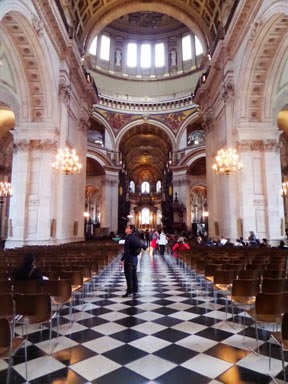
The famous dome


Next stop, St. Paul's Cathedral, pronounced Sint Paul's with an almost silent t. I keep thinking about St. Louis imagine calling it Sint Louis?  Traffic was light on this weekday out of season and with pre-purchased tickets we went through a separate line, no wait and got the free audio tour headset. Of course, the cathedral is spectacular, built on the site of previous churches right after the great fire of 1666 when most of London burned.  They say it's the second largest dome in the world after St. Peter's in Rome.

Situated on what is called Ludgate Hill, the highest ground in ancient London, the original church was founded in 604 AD. That one was burned during a brief return to paganism but rebuilt in the 8th century.  That one burned down, along with much of the city in 1087, shortly after the Norman conquest; this was only the first "great fire".  The Normans under William began a replacement, built largely of wood, and that took more than a century to complete. By the mid 1600's, that church was in bad shape, had been vandalized during the Civil War (a lot of anti church sentiment) but the second "great fire", this one in 1666, gave a good pretext to raze the Norman cathedral and build a spectacular new one. The architect was Christopher Wren, the premier designer of the age, and the structure was largely completed in his lifetime being dedicated in 1711. It was financed by a tax on coal, the main energy source of the time.

Aerial view of St. Paul's (net image)

The cathedral is one of the most recognizable sights of London; its dome has dominated the skyline for 300 years. At 365 feet high, it was the tallest building in London from 1710 to 1962, and its dome is also among the highest in the world. It is the location for many notable weddings, funerals, and other celebrations.
Statue of Queen Elizabeth out front


No sooner did we get situated in the cathedral, then a choir started singing the "Evensong" program, which they apparently do every day at 1pm.  We sat and listened: it was all teenage boys and girls, and they were very good availed of incredible acoustics.  When they stopped a song or hymn, you could still hear it for a few moments as it resonated under the dome.
The interior of the dome

Under the dome


Numerous signs throughout the cathedral pronounced  "no photos or videos" but so many people were using I-pads and phones to take snaps that I broke the rules a bit and snuck in a few photos.  These images can't do the this cathederal justice; a much wider angle would be necessary, a tripod, long exposures and such but I'm amazed what the hand-held camera was indeed able to pull off.
School children listen as teacher
points to the dome above


We walked through the main floor, listening to the various bits of information, history, etc., then went downstairs to visit the crypt where tons of famous people are buried amongst which was the tomb of Admiral Lord Nelson, Captain of the fleet that defeated Napoleon's forces at the battle of Trafalgar in 1804.  He was killed by a sniper on another ship and died moments after the battle was won and is a national hero of the highest rank.  Many others are here, some with tombs like Christopher Wren and others with plaques or crypts like Alexander Fleming, alas, too many to linger over.  Of note is that Lady Diana and Prince Charles were married here and the funerals of Margaret Thatcher and Sir. Winston Churchill were performed here.

It was possible to climb the stairs to the "Whispering Gallery" about half way up the dome, and even to climb all the way to the very top, but it was some 500 narrow and winding,steps to get up there and an equal number back down. Neither Evie or I felt up to it, especially with my vertigo at heights, so we had to be content with the view of London from the Eye- which was a much easier way of overlooking London.

The central "nave"


The cathedral was a particular target of the Nazis during the Blitz of London and although it was hit several times, it suffered no major structural damage.  One huge time-delay bomb crashed into it but the quick action by a bomb disposal squad defused it and carried it off.  When they detonated it at a remote location, the huge explosion showed that if it had exploded as intended, it would have destroyed the cathedral.  The leader of the bomb squad was knighted for his action! One of the iconic images of the war is of the cathedral, shrouded by smoke from fires, but standing, proud and unshaken.


Blitz photo by Herbert Mason, 1940"

"Wreathed in billowing smoke, amidst the chaos and destruction of war, the pale dome stands proud and glorious – indomitable".


We exited the cathedral and walked to the next square where there is a tall monument to the great fire of 1666, built on the spot where the fire is supposed to have started.
Pillar to commemorate the Great Fire of 1666


We then bought sandwiches at the "Pret a Manger" store on the square; ready to eat food.  We both got great baguette sandwiches and took them onto a bus back to the hotel where we ate them and rested before getting ready for the big event of the first week and Evie's BIG treat: The Classical Spectacular at the Royal Albert Hall (RAH)!

After our rest period, we took a taxi to the venue because it was raining hard by now. Eve though it's only on the other side of Hyde Park with traffic and the roundabout way that traffic must go to get there, it was L20 with the tip!  Living large!!

The RAH is quite something, perfectly round, three or more tiers with lots of velvety seats all in plush Royal Red. It was opened in 1871 and is named for Queen Victoria's consort, Prince Albert; it hosts at least one event for every day of the year from classical to pop, rock, and even school functions.

Web photo of the Royal Albert Hall

The show was very good, with the Royal Philharmonic Orchestra conducted by John Rigby, augmented by the Welsh Guard band and two choirs, plus a full laser light show. They played several patriotic British pieces, including "Land of Hope and Glory" and "Rule Britannia" (repeating the final chorus several times, with lots of people singing along and waving flags) and finished with the 1812 Overture by Tchaikovsky, complete with two thundering cannons and period dressed soldiers firing muskets from the gallery..

We were upstairs with a very good view of the proceedings, better than being close on the floor because of the view of the entire stage and of course the light show. I took a couple of photos and one turned out with a pretty good exposure!

The Classical Spectacular concert

We took a bus from the front steps of the RAH that went back up to Bayswater Road where we stopped in a restaurant for a late meal. I was pleased to find a steak and potatoes with a beer for L10. We had to wait quite a while but it was good and we just hopped on the next bus; even at 11:30 at night we didn't have to wait long and in minutes we were back  in our room and ready for bed.

Wednesday 19th March: British Museum: Leicester Square and the Criterion

By now I'm a little tired of the same breakfast, even though they have a nice buffet with scrambled eggs, English sausage (small and plump), hash browns, and even baked beans!  So I chose two different cereals and milk, there was fruit available and plenty of milk with some good bread to toast and butter and jam but, alas, no peanut butter here.  The coffee is very good, two different juices (orange and apricot), various scones, rolls and surprisingly good cheeses, apparently an European breakfast essential? There was also fruit salad, grapefruit slices and yogurt. It's a good way to start the day.


Wednesday we have set aside for the British Museum, an easy bus ride from the hotel, straight east on Bayswater, which turns into Oxford Street, past Selfridge's and all the shops, to Bloomsbury, only a few miles.
Evie in front of British Museum

The museum is dedicated to human history and culture, and its collection "is among the largest and most comprehensive in existence and originates from all continents, illustrating and documenting the story of human culture from its beginnings to the present." (Wikipedia)

The original museum opened in 1759 and had to be expanded multiple times before they finally had to demolish it; the current building was completed in stages, beginning in 1823 and finished in 1857.  The style is Greek Revival, the facade is finished in Portland Stone and granite from South England; a special tramway was built to transport it and other additions followed, and today it is one of the largest museums in the world.

The Museum housed the British Library for most of the century and featured a famous circular reading room but they ran out of room (over a mile of new shelf space required each year!). In the late 90's they moved the library to a new building and used the space for a new and beautiful glass roofed "Great Court" which opened in 2000. At two acres, it is the largest covered public space in Europe. The natural history collection was spun off to the separate museum in the 1880's, now one of the world's great collections in itself.
My shot of "Great Court"
Web shot of same court, much wider angle lens!
There is a new reading room in the center building but it was undergoing yet another remodel when we were there and not open.
Web image of Reading Room when open


Video of expanse of the Great Court


They had the original Rosetta Stone on display, many Greek statues and friezes from the Parthenon, some Aztec and Chinese items, lots of Egyptian artifacts, including the mummy of Cleopatra.
The famous Elgin room, with salvaged friezes and marbles from the Parthenon. Elgin gleaned permission from the Sultan for his artists to remove the Parthenon marbles at his own expense which would have been otherwise destroyed in those times.

Beautiful Greek sculpture

The original Rosetta Stone (discovered in 1800) enabled deciphering of Egyptian hieroglyphs.


We spent nearly 4 hours perusing the objects, too many to absorb in one trip. We didn't even get to a great many of the rooms and had no time really for studying anything in greatdetail. There was a large room devoted exclusively to Chinese ancient pottery ware and a much smaller room with some Aztec artifacts.

Chinese pottery

Aztec mask of the "Fire Serpent".


We had lunch in the little coffee shop in one corner of the Great Hall. Excellent food: We had great sandwiches on fresh baguettes. Reasonably priced with open seating at large tables, it was a very necessary respite.

Cafe corner under the dome

We finally left late in the afternoon and took a bus from the museum down to Piccadilly Circus, that word being a corruption of the Latin word for "circle". I always wondered about that, having read so many John LeCarre novels that mention them. There are a number of big intersections in London bearing the title of Circus. Each of the buildings at the four corners is concave and there is generally a monument in the middle and a roundabout street intersection.

We walked from there through the big shopping district, doing some window shopping and being shocked at the prices! We were headed to a famous jazz club that Evie used to frequent, Ronnie Scott's in Soho,  to see if we could get tickets for a show that evening, but when we finally found it, we were informed that the show was sold out! Rats! I was so hoping to see some live music at a club in London!

We found our way to the famous Leicester Square (pronounced Lester), the very center of the West End district of playhouses and theatres. We had dinner at a modest place right on the square called Muriel's, right in front of the statue of Shakespeare.

Muriel's on Leicester Square
The Bard resting


I had a version of Fish and Chips using Haddock instead of Cod (I couldn't tell the difference), but it was good and not very expensive. I was shocked when they wouldn't accept my American Express (AE) card: fortunately, I also brought a Visa card but prefer to use the AE, so I was a bit peeved over that. I found out that AE has exorbitant vendor fees and is the number one card in Europe used in frauds, making vendors less likely to accept it for payment.  .

We then walked to one of the theaters only a block away and chose to see "The 39 Steps", billed as a comedy.  Most of the theaters have the usual fare, Lion King, Les Miserable, one of the new additions is War Horse (already saw the movie) and such, any of which we could see as they came to Sacramento or in the movies so I thought this would be a good local alternative.  They also refused to accept AE, so Evelyn had to use her card at L25 each ticket.  The theater was old and very pretty inside, small, but with boxes on the sides and three levels. It was called The Criterion and the building was from the 1880's.
The Criterion theater off Leicester Square
The interior before the play


The play turned out to be a funny adaptation of the original Hitchcock movie from 1935, with five actors, four of which played multiple parts, some at the same time!  To show a train journey, they had a small toy train cross the stage, to sound effects.  It was good, and gave us a taste of small theater rather than the giant production pieces.  We're hoping to see Agatha Christie's  "The Moustrap", apparently the longest running play on Earth, but that will have to wait until we return from the countryside where we are headed on Friday morning.

After the play, we had a short walk to the tube entrance although many steps down to the train. then off that line and quite a walk, all via stairs and passages underground to the connecting tube line that takes us to within a few steps of the hotel.  I think we made it back by 11pm.  We watched some news on the tele (not referred to as TV in these parts) which was still completely dominated by speculation about the missing Malaysian plane. The cable in the hotel is good with lots of choices and an amazing number of American sitcoms on; the Wi-fi is free and robust so that I can continue to blog. To bed around midnight!

Tuesday, March 25, 2014

Tuesday 18th March: Oxford Sreet, Mr. Bassey, Waterloo Station and the London Eye

Evelyn got us switched to a bigger room yesterday, so now we have a nearly king size bed and more storage in a larger armoir, with a window to the front street--although it's a floor to ceiling window, it will not open for a little air.
Larger room at Grand Royale

A few things I've noted so far:
The toilets have two nested buttons on top,  one smaller with a single dot, the other larger,, with two dots.  You can guess what they do! It is a water saving device that I'm surprised hasn't been introduced in California at least!

Also, the wall plugs, which are 240 Volts and with much bigger pugs, all have an on-off switch next to them!  When I plug my converter to USB charger device, you still have to turn the plug on!  How wierd is that!

Tuesday morning we took the bus from the hotel, straight across Bayswater and got off at Selfridges, the department store popularized just recently in the PBS series. We took pictures out front, then walked through the place, but when I saw a normal pair of jeans for L150, I realized that I didn't want to buy anything in that store!
Selfridge's Dept. Store

Me out front of famous department store


Then we continued on that line to the same train station we came into last night, directly underneath the Shard.
The Shard, this time from directly below.


We checked out the lobby of the skyscraper and found that it costs over L20 each to take the elevator (or "lift" in England) to the top.  I'm sure the view would have been great, but it seemed an expensive ride and we declined (having already purchased tickets for the London Eye). We found out that the the observation deck, on the 72nd floor is 804' from the ground, surpassing the London Eye (at a little over half that) as the highest public viewing point in the city, and it was completed only a little over a year ago (February, 2013).

We then boarded a train and headed south.
One of the many styles of surface trains, for local travel

Evie on board the trrain


This time our journey was to the former village, now suburb, of Dulwich (pronounced "Dullidge") in order to visit another one of Evie's friends, this time an long-time friend of her parents, a gentleman by the name of Ted Bassey, long retired and in his 80's. We walked to his house from the station, only about 5 minutes, and after the a pleasant tea and talk, he drove us in his car to the golf club for lunch.

It was very elegant, perched up on a hill providing all a view across to downtown London off in the distance and golfers  walking on the course; no one had golf carts and strolled around in the on/off light drizzle.
The golf course with barely visible downtown

Evie and Mr. Bassey


I chose a very unusual option from the menu, pork belly.  I've had lots of versions of pork before but never that.  It was a little fatty but featured baked potatoes, beans and carrots and a nice gravy which was was quite good.


Pork belly at the country club


Mr. Bassey kindly dropped us at the station afterwards and we headed back into town. The trains are clean, frequent, on time, and very fast. We got off at the last stop, right underneath the Shard once again, took the tube from there to Waterloo station, immortalized for me in several Kinks songs ("Waterloo Sunset", and "Return to Waterloo"), and certainly one of the places I wanted to see. It was yet another magnificent station, huge glass ceilings arching overhead, a huge electronic message board listing all the schedules, restaurants, shops, and lots of people. It is said to be Britain's busiest station, with over 92 million passengers a year. It has more platforms (21)and a greater floor area (more than 800 feet in length) than any other station in the United Kingdom. I read that a station was opened on the site in 1848, named after the site of Napoleon's defeat, a huge and much celebrated British victory--and a subsequent local area name, major street and even a bridge. The current building dates to 1922.  The main pedestrian entrance has a large arch, called the Victory Arch, dedicated to train employees killed during the first war.
Part of the concourse
The Victory Arch at Waterloo Station


A close up of sculpture above the Arch (from the web)


A large four-faced clock hangs in the middle of the main concourse. Meeting "under the clock at Waterloo" is a considered a traditional rendezvous spot.
The clock in Waterloo station (from the web)
One of many platforms at London Waterloo (web photo)


I took some pictures inside, but certainly didn't explore the entire complex, which includes the tube station underground and a smaller station next door called Waterloo East, and even 5 more platforms that until recently hosted the Eurostar express, called Waterloo International, but that was transferred to St. Pancras in 2007.

In addition to being the subject of several of Ray Davies' tunes (the Kinks), it has been used in many movies, including "The Bourne Ultimatum" among many others, and even TV, including "Waking the Dead" and our favorite, the BBC series called "MI5" here, but originally "Spooks" in England. 

After the tour of Waterloo Station, we then exited through the north walkway, and passed the huge Imax theater across the street, then wandered the several blocks back to the river where we found ourselves at the London Eye, the huge ferris wheel type viewing device erected for the Millenium celebration in 2000 and also referred to as "The Millennium Wheel".
 

One the way we encountered one of the great information signs that are found throughout London, showing you not only where you are, with a detail inset, but a circle showing a five minute walk radius.  This one shows the Waterloo complex, the London eye, and three of the bridges.
Approaching the London Eye. The building on the left houses the Lambeth County Hall, two hotels, and an aquarium!


The London Eye was the tallest Observation Wheel in the world when it was completed in 1999, but has been surpassed twice since, although none has the cantilevered design that makes this one unique, and it is still the tallest such viewing platform in all of Europe at 443 feet!  It serves a little like the Eiffel Tower does for Paris, a symbol and place to view the city, although I imagine mostly foreign tourists like us utilize it. It has a predecessor, the Great Wheel, built for the Empire of India Exhibition in London, opened to the public in 1895, and at 308' was a real whopper for its day.  Unfortunately it was a wooden Ferris Wheel, and only lasted until 1906.  This one is all steel, with parts of its construction meted out to various countries in Europe, and has already outlasted the earlier wheel, and should stand for a long time.

My river view of the Eye.  Note the cantilever support, unlike most Ferris Wheels, supported on both sides.


 It has 32 air-conditioned cabins, each can hold some 25 people when necessary, although we were lucky and had no wait and only a half dozen passengers sharing the cabin. It keeps the cabins stable through an ingenious device, always horizontal no swaying, and takes you up over 400 feet--very scary if you look down, and I could hardly bring myself to stand while it was at the top, but for the rest of the ride, which takes about a half hour,I was able to tolerate the heigth pretty well..  Very good views all over London, although looking into the sunny side wasn't optimal. The weather was good, so it was a nice ride. The wheel doesn't stop--it goes slow enough that people can get on and off quite easily.

Evie on the Eye

View to northeast from the Eye

View to southeast, featuring Waterloo station at lower right

   After completing the 30 minute revolution, we walked along the river's edge, called the Albert Embankment on this stretch of the river, and bought some postcards at a stall.
Evie at British souvenir stand on the Embankment
 We then continued on foot over the Westminster Bridge to the famous house of Parliament with Big Ben chiming as we got there.
House of Parliament from the Westminster Bridge

Big Ben, with nice late afternoon sun!


I got my required photos, tourist snaps of course, but the light was nice and I think they turned out better than I expected.

We finally mounted another bus that took us back to the hotel for a rest before our date with another of Evie's old friends, Angie and her son Jeremy.  After an hour's rest, we made it back to the tube for the journey north to the suburb of Kilbern.

Jeremy and Angie were waiting for us at a pub a block from the underground. We had a drink and talked a bit, then headed over to an Indian restaurant that they frequented, where we enjoyed a nice long meal.  Jeremy's wife Grace showed up--she had to drop their daughter at school or something--and it was so much fun that they invited us to have a Sunday Roast at their house when we return to London, so we set a date and headed back to the hotel by 11PM for another long day!